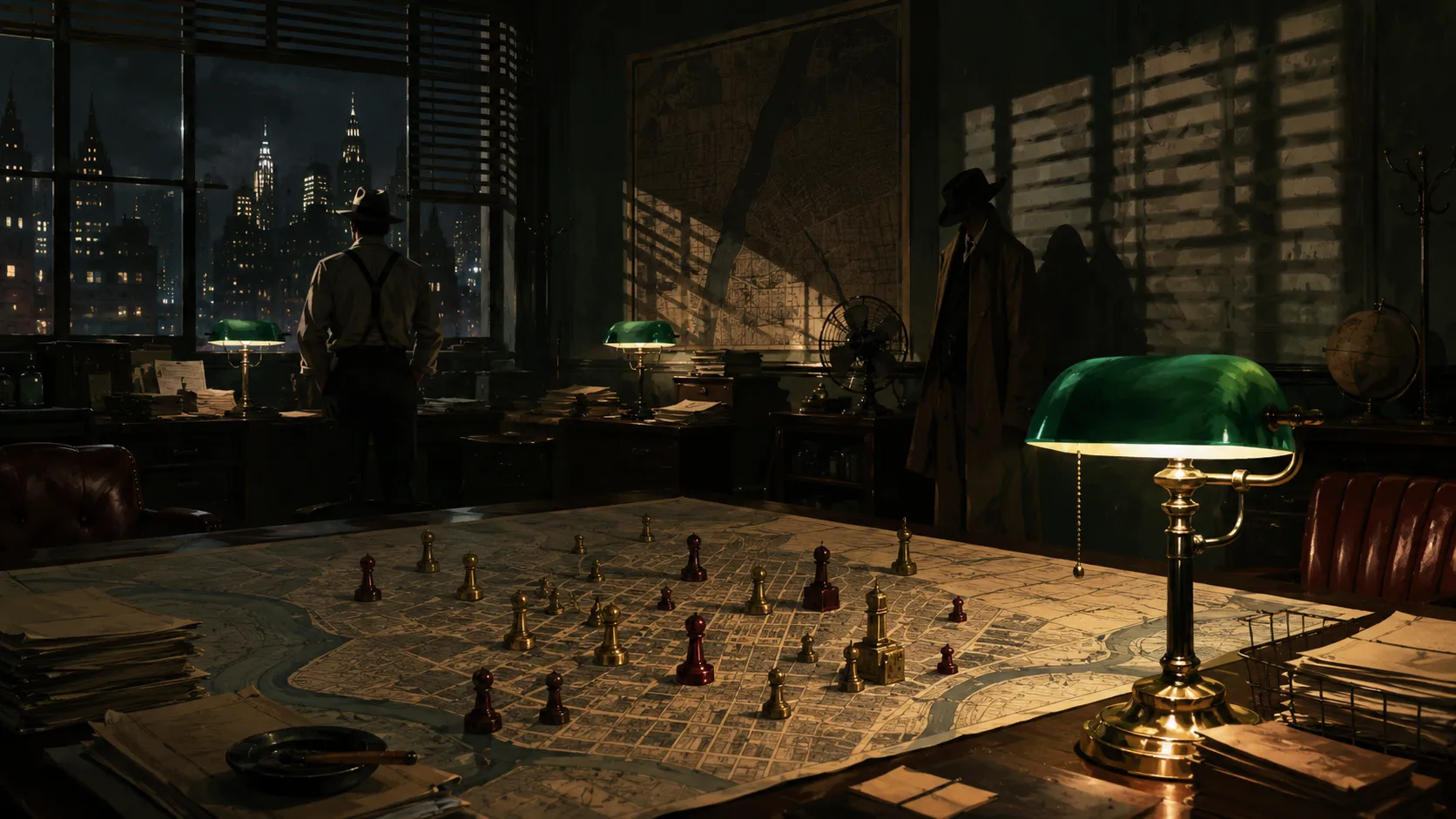
A manhunt and a heist on the same board
Operation Kingpin is a hidden-rank strategy game: both sides deploy face-down, and identity is the currency of the night. The Task Force hunts the Syndicate's concealed Kingpin — any officer who reaches him makes the arrest and closes the case. The Syndicate raids the other way: break into the Task Force's strongroom, steal an evidence locker, and run it home to an escape square — or put it to the torch. Unlike the classic games of this family, both players attack and defend at once; the pressure never sits on one side of the board.
The rules of engagement
- One piece, one square, each turn. Patrol Officers and Runners may instead sprint any number of clear squares in a straight line — and may strike at the end of it. A sprint publicly marks the piece as a sprinter: speed costs identity.
- Engaging reveals. Moving onto an enemy square shows both ranks to both seats. The higher grade stands; equal grades remove both; the winner takes the square when attacking, holds it when defending.
- Traps hold streets. Safe Houses (Syndicate) and Surveillance Units (Task Force) are immovable, take any attacker except the enemy's defuser — Bomb Disposal and the Lookout respectively — and persist until cleared.
- The stings cut down kings. The Undercover Officer defeats the Lieutenant, and the Inside Informant defeats the Chief Inspector — when attacking only. Both lose every other engagement they are ever in.
- The court date is the clock. Every night has a published move limit shown on the desk. If it arrives before the Syndicate has won, the case is heard with the evidence intact and the Task Force wins — so the Syndicate is always, by definition, the attacking side.
- The laws forbid stalling. No third consecutive shuttle between the same two squares; no recreating the same position a third time. The desk refuses an unlawful move and tells you which law it broke.
- A side with no legal move is neutralised and loses the night.
Ranks, counts, and who beats whom
Both rosters, with each district's counts shown as Docklands · City · Capital. Higher grade wins; equal grades remove both pieces. The grade ladder runs 1 to 8; the quick Docklands board fields no 5s or 7s — a shorter ladder on the same scale, so what you learn there transfers up.
| Grade | Task Force | Syndicate |
|---|---|---|
| 8 | Chief Inspector 1 · 1 · 1 | Lieutenant 1 · 1 · 1 |
| 7 | Special Branch — · 1 · 1 | Fixer — · 1 · 1 |
| 6 | Detective 2 · 3 · 4 | Enforcer 2 · 3 · 4 |
| 5 | Case Officer — · 3 · 4 | Fence — · 3 · 4 |
| 4 | Forensics Officer 3 · 4 · 5 | Smuggler 3 · 5 · 6 |
| 3 | Bomb Disposal 3 · 5 · 6 — clears Safe Houses | Lookout 3 · 5 · 6 — dismantles Surveillance |
| 2 | Patrol Officer 5 · 8 · 9 — sprints | Runner 6 · 10 · 11 — sprints |
| 1 | Undercover Officer 1 · 1 · 1 — stings the Lieutenant · Informant 1 · 2 · 2 | Inside Informant 1 · 1 · 1 — stings the Chief Inspector |
| Trap | Surveillance Unit 4 · 6 · 9 | Safe House 4 · 6 · 9 |
| Objective | Evidence lockers 1 · 2 · 2 | The Kingpin 1 · 1 · 1 |
So what takes down a grade 8? Nothing outfights one — and that is by design, on both sides of the board. There are exactly three answers: trade your own 8 into it (equal grades remove both), catch it with your sting piece (the Undercover Officer takes the Lieutenant, the Inside Informant takes the Chief Inspector — attacking only), or let it blunder into one of your traps. The mirror is the real lesson: until the enemy's grade-1 sting is accounted for, your own 8 is never safe either — and note that the stings answer only the 8s: a grade-7 Special Branch or Fixer walking the middle of the board fears nothing but the other 7, the two 8s, and the traps.
The evidence game
Evidence is a physical object with a life of its own. Stealing is silent about rank but loud about fact: the carrier is marked hot for everyone to see, and slows to a single square per turn — you don't sprint with a strongbox. A Smuggler may spend its turn handing the cargo to an adjacent Syndicate piece, and a rehearsed relay of Smugglers moves evidence faster than any single runner — though the hand-off names the Smuggler. A caught carrier drops the locker where it fell; either side may take it up, and the Task Force re-secures it by walking it home and lodging it back in the strongroom, where it can be stolen again. An Enforcer holding evidence may burn it — slower and more brazen than the heist, but burn both lockers and there is no case left to prosecute.
Three districts
- The Docklands — the quick board: 7×8, twenty-one pieces a side deployed three rows deep, one locker, four traps each. The teaching table.
- The City — the standard board: 9×10, thirty-six pieces deployed four rows deep, classic-density: just two contested rows of open street between the armies, the broad High Street up the middle and a knife-edge alley on each flank. Alleys are ambush country; the High Street is where strength shows.
- The Capital — the long game: 11×12, forty-four pieces four rows deep, four routes between the sides and nine traps each. An hour or more of trench-work, saved between visits.
A fair opponent — documented, not promised
This is the tactical desk's first hidden-information game, so its standing law is written plainly: the computer never reads your hidden ranks. What it receives on its turn is exactly what you can see from your chair when playing its side: piece positions, which pieces have moved or sprinted, ranks revealed by engagements, the public evidence markers and the move history. From that it imagines arrangements of your hidden pieces consistent with the evidence — the same bookkeeping a strong human keeps — and plays against those. Difficulty settings are honest strength settings: the easiest opponent weighs one imagined arrangement, looks one move ahead and plays a random legal move a quarter of the time; the strongest weighs five arrangements, three moves deep. None of them ever sees more than you would.
Reading the night — five habits
- Watch what never moves. The unmoved pieces hide the Kingpin, the lockers and every trap. The board's silence is a map.
- Spend your sprinters on questions. A Runner poked into the enemy's ranks buys information with a cheap piece — and forces engagements that reveal.
- Walk your defusers with the assault. An attack on a trap-screened corner goes nowhere without Bomb Disposal in the column — and a Lookout walking point does the same for the Syndicate.
- Hunt the sting before you commit your king. Until the enemy's grade-1 specialist is accounted for, your Chief Inspector or Lieutenant walks in danger.
- Count the escort on a hot carrier. A stolen locker is public: the chase is winnable if you cut the road ahead of the carrier, not behind it.
Questions from the desk
What is Operation Kingpin?
Operation Kingpin is the flagship of the bureau’s tactical desk — a two-player hidden-rank strategy game rather than a case file. Every piece starts face-down: the Task Force must find and arrest the Syndicate’s concealed Kingpin, while the Syndicate must steal an evidence locker from the Task Force’s strongroom and run it to an escape square — or burn both lockers. Each side attacks and defends at once, and every engagement, sprint and hand-off reveals a little more about who is who.
How do the piece grades work?
Each movable piece carries a grade from 1 to 8. When one piece moves onto an enemy square, both ranks are shown to both players: the higher grade stands and the lower is removed; equal grades remove both. The winner takes the square when attacking and holds it when defending. Grades stay hidden until an engagement — bluffing with a bold Runner is half the game.
What do the traps do?
Each side hides immovable traps among its ranks. The Syndicate’s Safe Houses eliminate any Task Force raider except Bomb Disposal, who clears the trap. The Task Force’s Surveillance Units arrest any Syndicate piece that walks in — except a Lookout, who spots the watchers and dismantles the stakeout. Traps persist after they trigger and are only removed by the piece trained to clear them, so a discovered trap still owns its street.
What are the stings?
Each side fields one grade-1 specialist that beats the enemy’s strongest officer — but only when attacking. The Task Force’s Undercover Officer takes down the Lieutenant; the Syndicate’s Inside Informant takes down the Chief Inspector. Attacked, either of them loses to everything. Timing the sting — and protecting your own top rank from the enemy’s — is a core rhythm of the game.
How does the evidence work?
Any Syndicate piece that reaches an evidence locker steals it. The theft is public: the carrier is marked hot, though its rank stays hidden, and it slows to one square a turn. Deliver the locker to an escape square on the Syndicate’s back row and the night is won. Smugglers can pass the cargo to an adjacent Syndicate piece — a relay that outruns any single carrier, at the price of naming the Smuggler. If a carrier is caught, the evidence drops where it fell: either side can pick it up, and the Task Force re-secures it by carrying it home to the strongroom. An Enforcer holding evidence can burn it instead — burn both lockers and the case collapses.
What are the three districts?
The Docklands is the quick board — 7×8, twenty-one pieces a side, one locker. The City is the standard table — 9×10, thirty-six pieces deployed four rows deep, so only two contested rows of open street separate the armies, with the wide High Street flanked by two one-square alleys. The Capital is the long game — 11×12, forty-four pieces, four routes and nine traps a side. Tactics learned on the small board transfer up; the bigger boards simply give the hunt more shadows.
Do the computer opponents cheat?
No — this is the tactical desk’s standing law, and it matters more here than anywhere, because this is the desk’s first hidden-information game. The computer receives exactly what you can see from your chair: the positions of your pieces, which of them have moved or sprinted, any ranks revealed by battles, and the public evidence markers. Your hidden ranks are never given to it, at any difficulty. It plays by imagining possible arrangements of your hidden pieces that are consistent with what it has observed — exactly what a strong human opponent does — and choosing against them.
How do the difficulty levels differ?
Honestly: harder settings think harder, they never know more. The easiest opponent considers one imagined arrangement of your hidden pieces, looks one move ahead, and plays a completely random legal move a quarter of the time — a documented handicap, like a distracted junior. The middle setting weighs several arrangements two moves deep; the hardest weighs five arrangements three moves deep. All three read the same public information.
Can I play with a friend?
Yes — set both seats to human for a hotseat match on one screen. The desk runs a handover curtain between every turn so neither player ever sees the other’s hidden ranks: deploy in secret, pass the device, play, pass again. You can also set both seats to computer opponents and watch a night play itself out over the Task Force’s shoulder.
What stops a match from stalling forever?
Three things. The court date is the big one: every night has a published move limit, shown on the desk, and if it arrives before the Syndicate has won, the case is heard and the Task Force wins — so the Syndicate can never afford to sit back. Beneath that, two standing laws are enforced with an explanation whenever a move is refused: the two-square law forbids a piece shuttling endlessly between the same two squares, and the pursuit law forbids recreating the very same position a third time.
Why does moving fast reveal my piece?
Patrol Officers and Runners may sprint any number of clear squares in a straight line — the only pieces that can. So the moment a piece sprints, everyone knows its class. That is the price of speed, and it is symmetrical: their runners pay it too. The same principle prices other conveniences: a Smuggler’s hand-off names the Smuggler, and a burning locker names the Enforcer.
How is this different from the bureau’s case files?
Every case file on this site is a puzzle with exactly one provable answer, generated fair and checked by a solver. Operation Kingpin is a strategy game with an opponent: you can play well and still lose, and no two nights are alike. That is why it lives on the tactical desk. What it shares with the case room is the part that matters — complete public rules, a fair opponent, and nothing hidden from you that a human across the desk would not also hide.
Is Operation Kingpin free?
Yes. All three districts, all difficulty settings, hotseat play and the deployment schemes are free in your browser, with no account. Your match — deployment and all — is saved locally between visits, so a long Capital night can be played across several evenings.