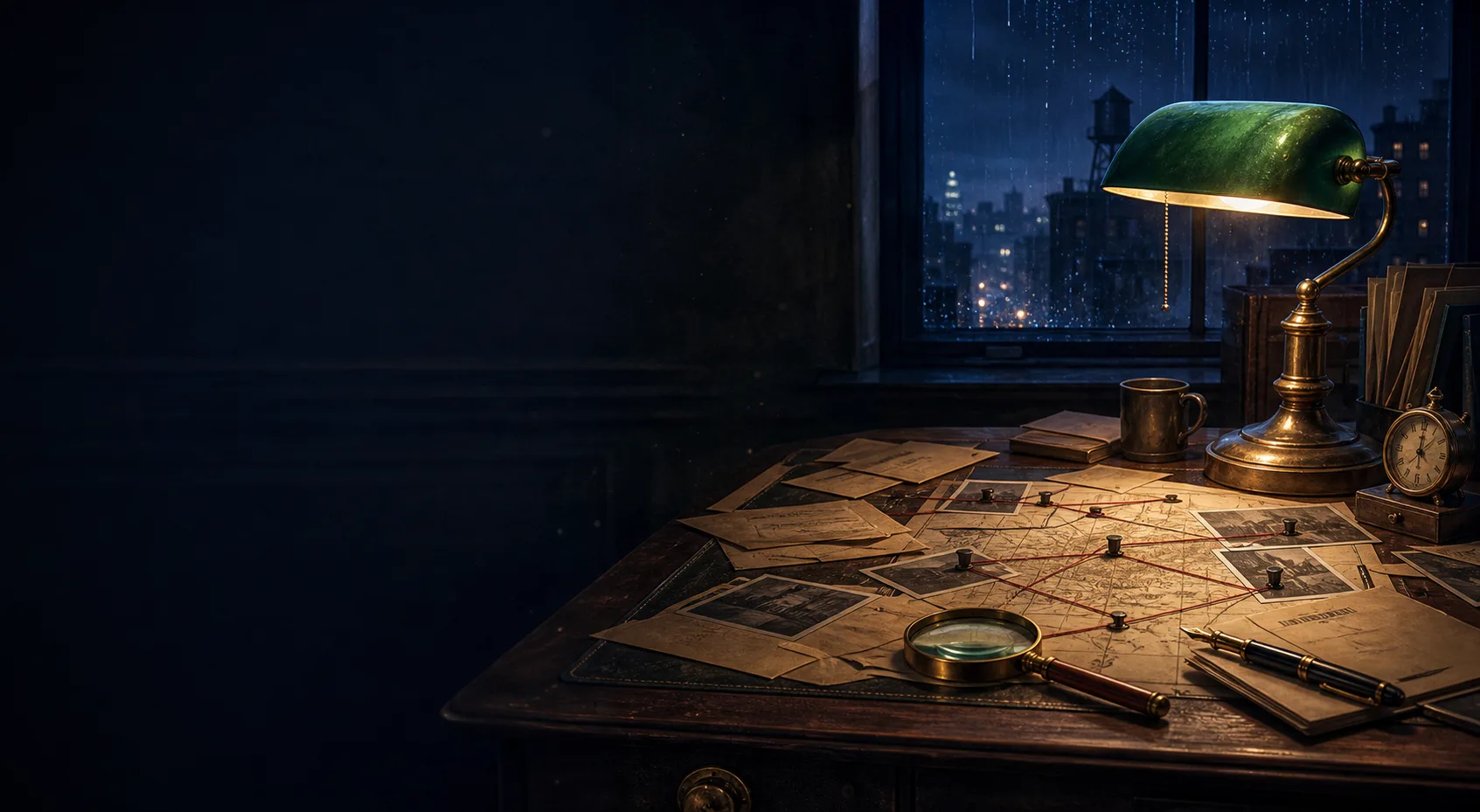
What the game is
The Red Thread is a route-drawing mystery — the classic slitherlink loop puzzle, rebuilt as a detective case. In the night, someone slipped into the grounds of a country estate, took something that was not theirs, made one complete circuit and left exactly the way they came in. The groundskeeper walked the beds at dawn and counted, plot by plot, how many sides show the intruder's tracks; that report is your only map of the route.
You reconstruct the round by pinning red thread along the edges between plots. Tap an edge once to pin thread, twice to cross it out as clear, three times to lift the mark — or press and drag along a path to lay a run of thread in one stroke. The finished route is one unbroken loop, and it does more than satisfy the counts: lettered landmarks sit on the map, and every landmark your thread reaches pins a piece of evidence. The route the counts force passes exactly one way in, one garden walk, one window — and only one suspect's file accounts for all of it.
Case procedure
- Clear the zero plots first. A count of 0 means the route never touched that plot — cross out all four of its sides and enjoy it.
- Pair every pin. The route passes through a map pin completely or not at all: every pin touches exactly zero or two threads. Two threads at a pin clear its other edges; a thread with only one way onward must continue there.
- Fill the plots with no slack. When a plot's count equals its open sides plus its threads, every open side carries thread. When its count is already met, the rest are clear.
- Sweep one plot at a time. Lay out every legal way a plot's count can sit across its open sides — remembering what each corner pin can still legally do — and keep whatever falls the same way in every arrangement. This is the quiet workhorse of the whole map.
- Never close the loop early. An edge that would join the two ends of your thread into a loop stays clear until every count is met — the intruder made one circuit, not two.
- Watch the evidence board. Each landmark your thread reaches pins a fact about the route. The letters on the map match the key beneath it.
- Read the route against the dossiers. Clear every suspect whose file cannot account for a pinned landmark. When one dossier explains the whole round, accuse.
The rulings that matter most
- Counts number sides, not tracks. A plot's number counts how many of its four sides carry the route — nothing more. An unnumbered plot is unreported, not untouched.
- One unbroken circuit. The route never branches, never crosses itself, and returns to where it began. Every map pin touches exactly zero or two threads — and the map turns thread red the moment any of yours breaks this law, so a round can never quietly go wrong.
- The loop closes last. Joining your thread's two ends is only ever legal when it completes the round with every count met. Until then, that edge is clear.
- Verified segments are settled. Brass-marked thread was found at the scene and brass crosses were verified clear — they cannot be changed and never lie.
- Crosses are never required. The case is judged on the thread alone; crosses are your working notes and can be wrong without penalty.
- Landmarks pin themselves. The moment your thread runs along a landmark's edge, its evidence pins to the board. The thread decides which gate, which walk, which window — you never have to guess.
- No landmark convicts alone. Every case is built so each piece of route evidence leaves at least two suspects standing — the warrant always needs the whole round.
- Decoy lines prove nothing. At higher ranks dossiers carry lines — where an evening was spent, what boots are favoured — that no stretch of thread speaks to. They neither clear nor condemn anyone.
Choosing a rank
Garden Gate (5×5 grounds, four suspects) teaches the loop laws in about ten minutes, with generous counts and dossiers different enough to read at a glance. Night Patrol (7×7, six suspects) is the full method: sparser counts, overlapping dossiers and a decoy line in every file. Cold Trail (10×10, eight suspects) is the long round — the sparsest counts, verified segments spent like currency where the logic genuinely needs them, and files where only combinations of landmarks single out the intruder. Bigger maps add more interlocking deduction, never unfair steps.
Fairness, hints and reveal
Every case is generated and then proved before you see it. The generator's solver must complete the whole route using only the deductions described in this manual — the same reasoning you use at the map — which guarantees exactly one round fits the report and that no guessing is ever required. When a map needs more help, the bureau verifies another thread segment before the case ships; when it needs too much, the route is thrown away and regrown. The detective layer passes the same standard: the passed landmarks identify exactly one suspect, and removing any single landmark would leave at least two. Check flags marks that cannot be right without adding any of its own. Hints escalate politely: the first press names a deduction and the reasoning behind it; a second press points at the exact edge, and the pin is still yours to place. Reveal unseals the groundskeeper's own tracing and excludes the case from your cases-cracked tally. Wrong accusations are stamped on the file; the case stays open.
Printing a case
Any case can be downloaded as a PDF pack built entirely in your browser from the same case number as the on-screen map: the briefing and every dossier on the case sheet, one full wall map with counts, verified segments and the landmark key sized for pencil work, and an optional answer key showing the traced route, the pinned evidence and the warrant. Loop puzzles are print natives — a pack runs about three A4 sheets and suits classrooms, puzzle clubs and long train journeys, and the case number on the cover reopens the same map on screen.
Questions from the grounds
What is The Red Thread?
The Red Thread is a route-drawing mystery — the classic slitherlink loop puzzle rebuilt as a detective case. Someone crossed the grounds of a country estate in the night, made one complete circuit and left the way they came in. The groundskeeper’s morning report counts, plot by plot, how many sides of each garden bed show the intruder’s tracks. Pinning red thread edge by edge across the wall map reconstructs the route by pure deduction — and the landmarks the finished route passes identify exactly one suspect.
How do the plot counts work?
The number in each plot counts how many of that plot’s four sides carry the intruder’s route. A 0 means the route never touched that plot; a 3 means it ran along three of its four sides. Plots without a number are simply unreported — any number of their sides may carry thread. The route itself is one unbroken loop along the edges between plots: it never branches, never crosses itself, and returns to where it began, so every map pin touches exactly zero or two threads.
What are the verified thread segments?
A few edges come already settled by the bureau — a torn length of thread caught at the scene, or a stretch verified clear. They are marked in brass and cannot be changed, and they never lie. They are part of the case’s design: some maps need a fixed point or two before pure logic can carry the rest of the round, and the bureau supplies exactly as many as the logic needs.
How does the route catch the intruder?
Lettered tags on the map mark landmarks — ways in, garden walks, windows, corners of the grounds. The finished route passes exactly one landmark in each group, and each one pins a piece of evidence: which way the intruder came and went, which walk they kept to, whose window they passed beneath. Each suspect’s dossier records what its subject can account for. A suspect whose file cannot explain a pinned stretch of the route is cleared, and only one dossier accounts for the whole round. No single landmark convicts on its own — every case is built so the warrant needs the full route.
Is every map guaranteed solvable without guessing?
Yes. Every case is proved before you see it: the generator’s solver must complete the whole route using only named, human deductions — pin pairing, met counts, forced fills, single-plot arrangement sweeps and the one-loop law. If a map would ever require a guess, the bureau verifies another thread segment before the case ships, or the route is thrown away and regrown. The detective layer is proved the same way: the passed landmarks identify exactly one suspect, and removing any one would leave at least two.
What do Check, Hint and Reveal do?
Check flags any current mark that cannot be right, without adding marks of its own — it is always safe. Hints come in two strengths: the first press names a deduction and explains the reasoning that makes it — which pin or plot to work, and which law applies; pressing again points at the exact edge, though the pin is still yours to place. Reveal unseals the groundskeeper’s own tracing of the route, and a revealed case never joins your cases-cracked tally.
What are the case ranks?
Garden Gate is a 5×5 corner of the grounds against four clearly different dossiers — a whole case in about ten minutes, with generous counts. Night Patrol works a 7×7 map with sparser counts against six overlapping dossiers padded with a decoy line no thread ever speaks to. Cold Trail is the long round: a 10×10 map, the sparsest counts, eight dossiers and two decoy lines, where only combinations of landmarks single out the intruder.
Can I play on a phone?
Yes. The wall map sizes itself to the screen and every edge has a generous touch target — tap once to pin thread, twice to cross an edge out as clear, three times to lift the mark, or press and drag along a path to lay a run of thread in one stroke, turning corners as you go. A stroke only overwrites edges in the same state as the one it started on, so laying thread never destroys your crosses, and Undo takes back the whole stroke. Your marks save automatically between visits, and each case has a case number so the same map can be reopened.
Can I print a case?
Yes. Any case can be downloaded as a PDF pack built entirely in your browser from the same case number as the on-screen map: the briefing and every dossier on the case sheet, one full wall map with counts, verified segments and the landmark key sized for pencil work, and an optional answer key showing the traced route, the pinned evidence and the warrant. Nothing is uploaded anywhere, and the dialog shows the sheet count before you download.
Is The Red Thread free?
Yes. All ranks are free to play in your browser with no account or sign-up. A new case is one click away, and every case is generated fresh — the route is grown, proved fair, and dressed with new grounds, landmarks and dossiers, so no two nights on the estate read the same.